Culture & Tourism
Culture & Tourism
An explorative Project
CulturEye
Product Design | 5 weeks
My Role:
UX and UI Designer
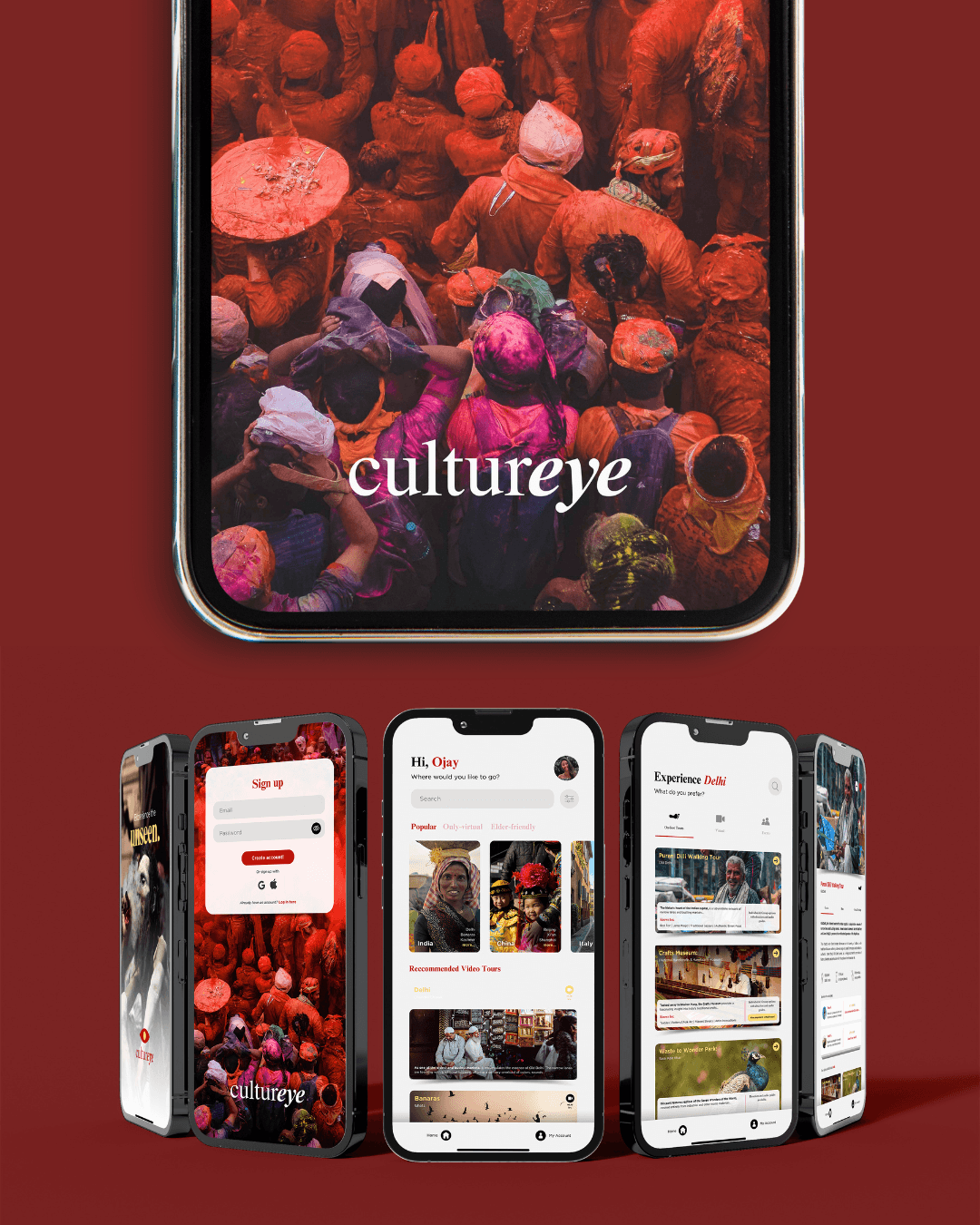
Drove research, information architecture, interaction design, and interface development for a mobile-first tourism app that foregrounds cultural depth.
Quick Summary:
Designed a tourism app to help travellers discover underrepresented cultural sites and narratives, In an saturated market CulturEye addresses gaps in accessibility, depth, and relevance.
Design systems
Qualitative User Research
Iterative prototyping and user testing
Iterative prototyping & user testing
Information architecture
Information architecture
Brief
Brief
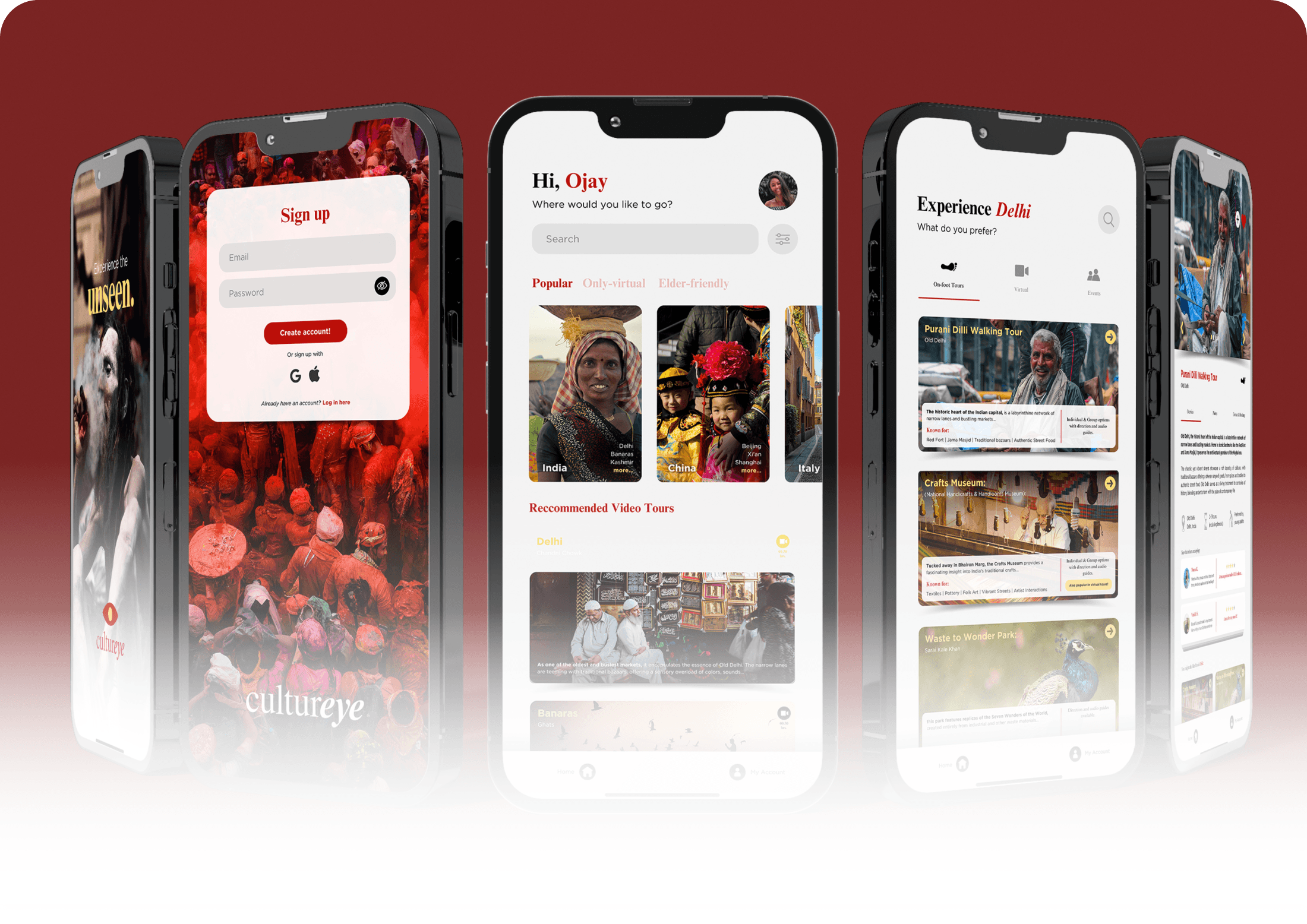
Culture Eye was conceptualised to bridge the gap between travellers and the rich cultural heritage of their destinations. Many significant cultural traditions, heritage sites, and local art forms remain overshadowed by mainstream tourism, leading to missed opportunities for deeper engagement (Richards, 2018; UNWTO, 2022). This project focused on designing an intuitive and immersive platform that transforms travel from logistics-based planning to cultural discovery.
Culture Eye was conceptualised to bridge the gap between travellers and the rich cultural heritage of their destinations. Many significant cultural traditions, heritage sites, and local art forms remain overshadowed by mainstream tourism, leading to missed opportunities for deeper engagement (Richards, 2018; UNWTO, 2022). This project focused on designing an intuitive and immersive platform that transforms travel from logistics-based planning to cultural discovery.
01
Limited discoverability
02
Lack of structured, reliable information
03
Generic experiences
01
Limited discoverability
02
Lack of structured & reliable info
03
Generic experiences
Culture Eye set out to solve these issues through a well-researched, engaging digital experience.
Culture Eye set out to solve these issues through a well-researched, engaging digital experience.
Literature Review
Secondary Research
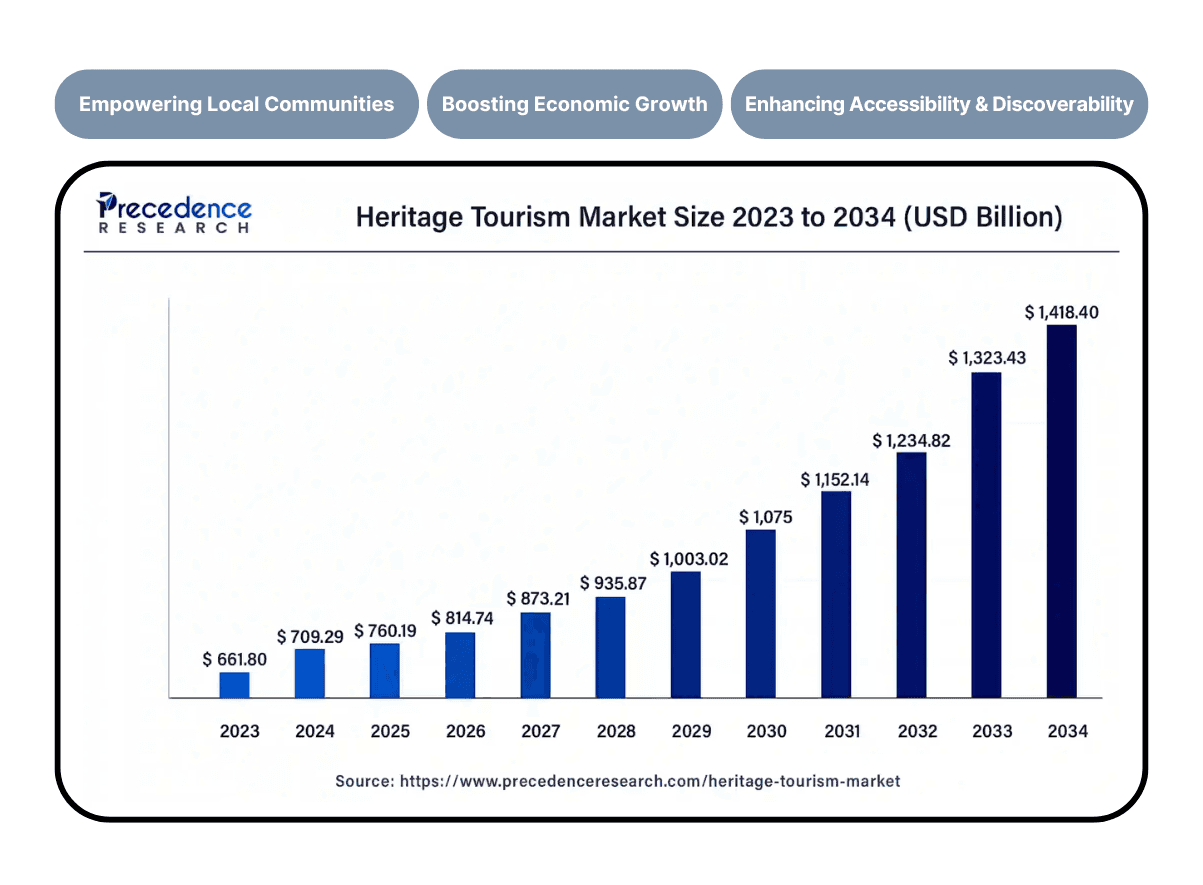
Recent studies show that modern travellers increasingly prioritise meaningful experiences over simply visiting landmarks (Pereira et al., 2019). Cultural tourism, in particular, offers rich opportunities for social learning, cognitive engagement, and emotional fulfilment (UNESCO, 2021). A UNWTO report (2022) further highlights that 90% of young travellers actively seek out unique cultural narratives, underscoring a growing demand for deeper, experience-driven exploration.
User Interviews
Primary Research
Interviews with 20 frequent travellers provided qualitative insights into how cultural experiences are discovered. While 70% preferred curated cultural recommendations over generic travel lists, 65% admitted relying on social media for inspiration- despite finding it unstructured and unreliable. Notably, 80% expressed a desire for a centralised platform to access cultural experiences, rather than having to navigate scattered blogs and forums.
Survey
Primary Research
A survey of over 200 respondents on travel habits and cultural engagement revealed that 95% were interested in exploring local cultures beyond typical tourist hotspots. However, 60% expressed frustration with the difficulty of accessing authentic, non-commercialised cultural experiences.
Competitive Analysis
Secondary Research
A competitive audit of travel apps such as Airbnb Experiences, Google Travel, and Culture Trip revealed key gaps in the market. Most lacked deep cultural narratives or interactive storytelling, offering surface-level listings instead. Additionally, none provided personalised recommendations based on users’ historical, artistic, or heritage-based interests.
Literature Review
Secondary Research
Recent studies show that modern travellers increasingly prioritise meaningful experiences over simply visiting landmarks (Pereira et al., 2019). Cultural tourism, in particular, offers rich opportunities for social learning, cognitive engagement, and emotional fulfilment (UNESCO, 2021). A UNWTO report (2022) further highlights that 90% of young travellers actively seek out unique cultural narratives, underscoring a growing demand for deeper, experience-driven exploration.
User Interviews
Primary Research
Interviews with 20 frequent travellers provided qualitative insights into how cultural experiences are discovered. While 70% preferred curated cultural recommendations over generic travel lists, 65% admitted relying on social media for inspiration- despite finding it unstructured and unreliable. Notably, 80% expressed a desire for a centralised platform to access cultural experiences, rather than having to navigate scattered blogs and forums.
Survey
Primary Research
A survey of over 200 respondents on travel habits and cultural engagement revealed that 95% were interested in exploring local cultures beyond typical tourist hotspots. However, 60% expressed frustration with the difficulty of accessing authentic, non-commercialised cultural experiences.
Competitive Analysis
Secondary Research
A competitive audit of travel apps such as Airbnb Experiences, Google Travel, and Culture Trip revealed key gaps in the market. Most lacked deep cultural narratives or interactive storytelling, offering surface-level listings instead. Additionally, none provided personalised recommendations based on users’ historical, artistic, or heritage-based interests.
Literature Review
Recent studies show that modern travellers increasingly prioritise meaningful experiences over simply visiting landmarks (Pereira et al., 2019). Cultural tourism, in particular, offers rich opportunities for social learning, cognitive engagement, and emotional fulfilment (UNESCO, 2021). A UNWTO report (2022) further highlights that 90% of young travellers actively seek out unique cultural narratives, underscoring a growing demand for deeper, experience-driven exploration.
User Interviews
Interviews with 20 frequent travellers provided qualitative insights into how cultural experiences are discovered. While 70% preferred curated cultural recommendations over generic travel lists, 65% admitted relying on social media for inspiration- despite finding it unstructured and unreliable. Notably, 80% expressed a desire for a centralised platform to access cultural experiences, rather than having to navigate scattered blogs and forums.
Survey
A survey of over 200 respondents on travel habits and cultural engagement revealed that 95% were interested in exploring local cultures beyond typical tourist hotspots. However, 60% expressed frustration with the difficulty of accessing authentic, non-commercialised cultural experiences.
Competitive Analysis
A competitive audit of travel apps such as Airbnb Experiences, Google Travel, and Culture Trip revealed key gaps in the market. Most lacked deep cultural narratives or interactive storytelling, offering surface-level listings instead. Additionally, none provided personalised recommendations based on users’ historical, artistic, or heritage-based interests.
These findings shaped Culture Eye’s key features- custom recommendations, structured narratives, and an intuitive UI that encourages heritage value destinations.
These findings shaped Culture Eye’s key features- custom recommendations, structured narratives, and an intuitive UI that encourages heritage value destinations.
Information Architecture
Information Architecture
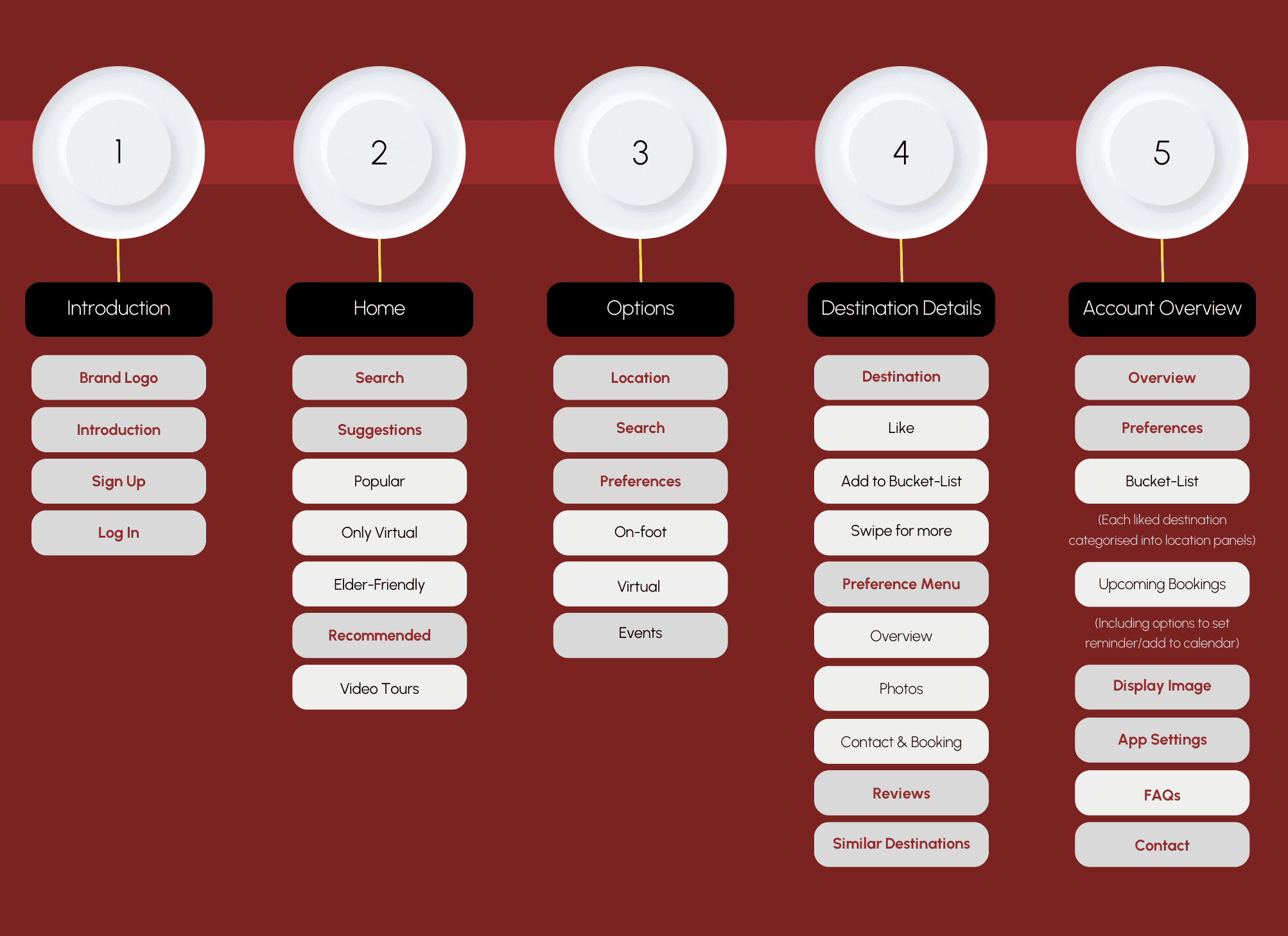
With these insights in mind, I first developed the app's information architecture, establishing a structured framework that guided subsequent design decisions.
With these insights in mind, I first developed the app's information architecture, establishing a structured framework that guided subsequent design decisions.
App Design Kit
App Design Kit
Cultural Motifs
Inspired by Madhubani, Kali Ghat, and Kalamkari art forms, which often depict eyes as a symbol of perception and discovery (UNESCO, 2021).
Inspired by Madhubani, Kali Ghat, and Kalamkari art forms, which often depict eyes as a symbol of perception and discovery (UNESCO, 2021).
Logo Evolution
From an initial full-figure silhouette to a simplified, culturally symbolic eye motif for better scalability.
From an initial full-figure silhouette to a simplified, culturally symbolic eye motif for better scalability.
Colour & Typography
A palette inspired by traditional Indian textiles and natural pigments, paired with serif fonts to balance heritage with digital readability.
A palette inspired by traditional Indian textiles and natural pigments, paired with serif fonts to balance heritage with digital readability.

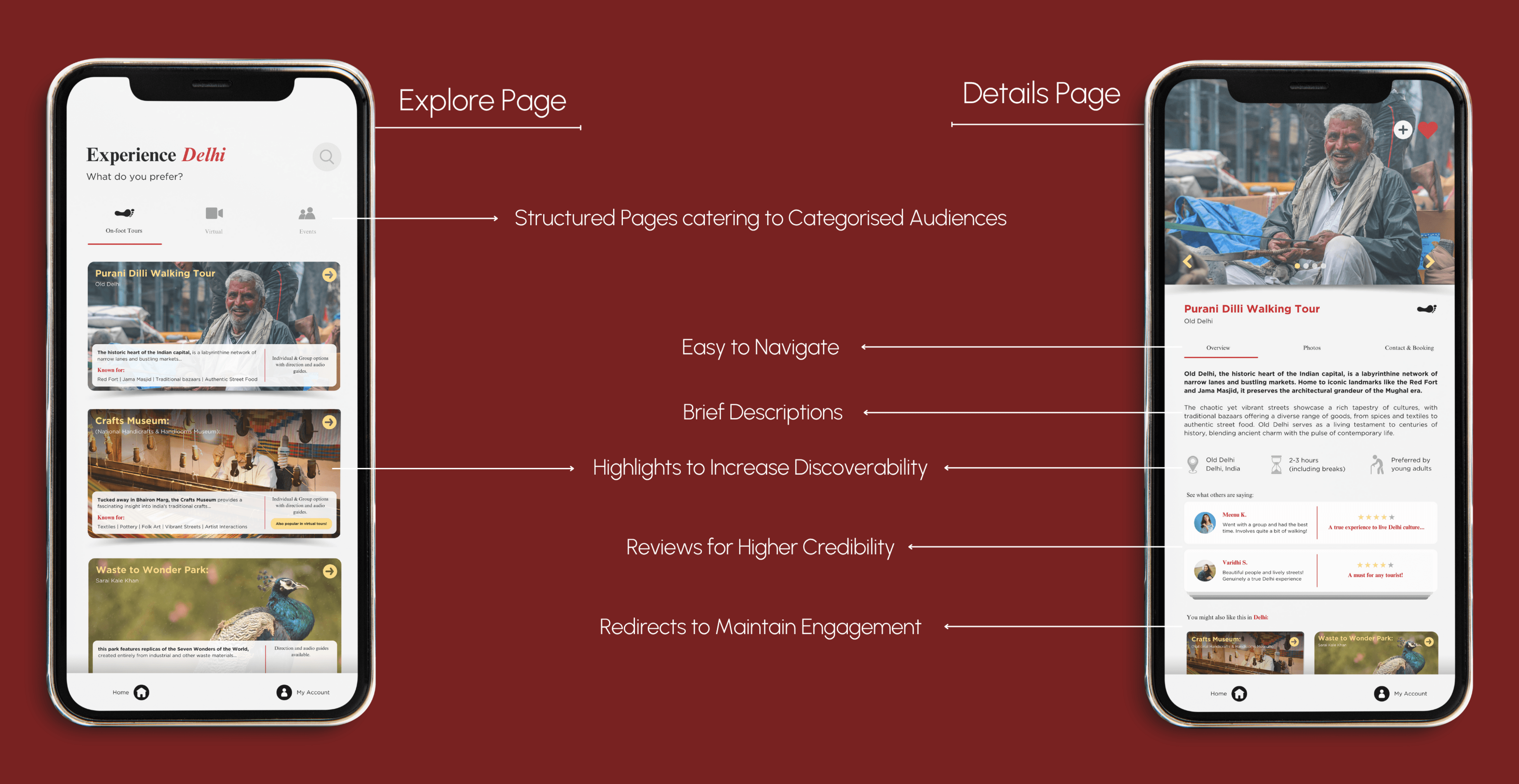
App Design Kit
App Design Kit
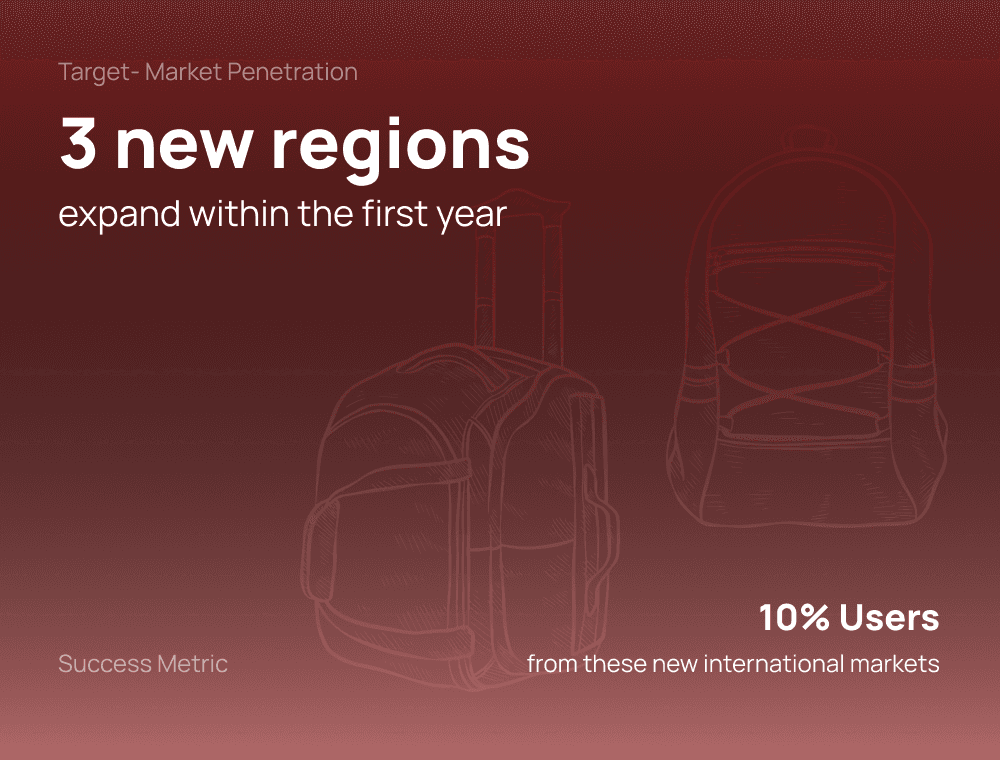
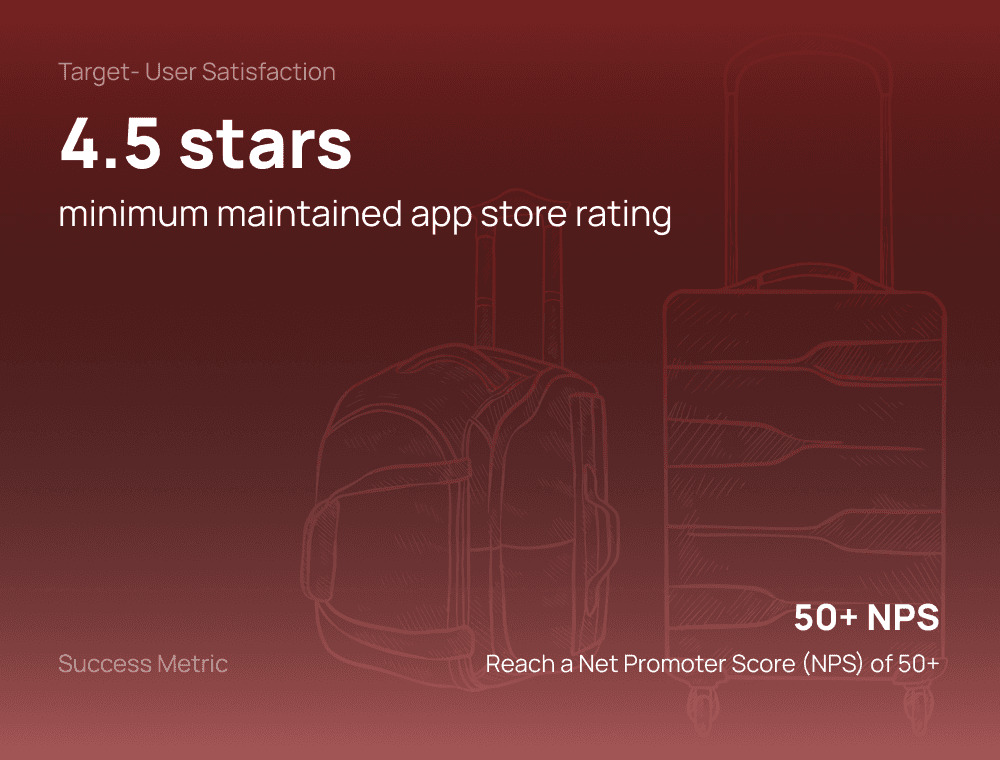
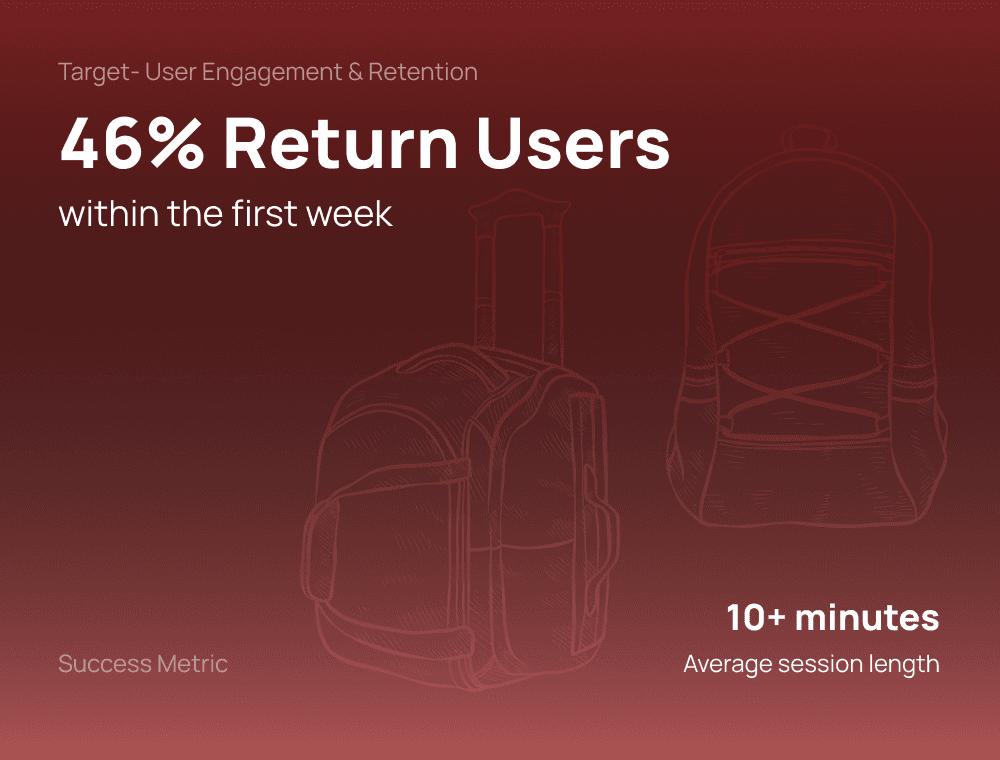
These insights are grounded in both academic and market research (see references at the end). This project showcases not just user interface design, but how thoughtful UI can serve a larger purpose: making culturally rich destinations- starting with India and China- more accessible and discoverable. The design is intentionally scalable, laying the foundation for a global platform.
These insights are grounded in both academic and market research (see references at the end). This project showcases not just user interface design, but how thoughtful UI can serve a larger purpose: making culturally rich destinations- starting with India and China- more accessible and discoverable. The design is intentionally scalable, laying the foundation for a global platform.
Reflections
Reflections
This project made me a more narrative-led designer, & calm systems thinker.
Designer Reflection
Designer Reflection
CultureEye made me a more culturally sensitive and narrative-led designer. I learned to navigate nuance without stereotype, communicate design value across disciplines, and lead with clarity through research, storytelling, and tech. Most importantly, I embraced the discomfort of omission- honouring attention as much as cultural accuracy.
CultureEye made me a more culturally sensitive and narrative-led designer. I learned to navigate nuance without stereotype, communicate design value across disciplines, and lead with clarity through research, storytelling, and tech.
Balancing Depth with Accessibility
Balancing Depth with Accessibility
Early prototypes were content-rich but overwhelmed users with dense text. Through iterative testing, I restructured stories into interactive, bite-sized formats- making cultural insight easier to absorb without losing nuance.
Early prototypes were content-rich but overwhelmed users with dense text. Through iterative testing, I restructured stories into interactive, bite-sized formats- making cultural insight easier to absorb without losing nuance.
Reducing Cognitive Load
Reducing Cognitive Load
The initial interface offered too many paths at once, leading to decision fatigue. Drawing on Cognitive Load Theory (Sweller et al., 2019), I redesigned flows to be more intuitive, allowing users to explore at their own pace without cognitive strain.
The initial interface offered too many paths at once, leading to decision fatigue. Drawing on Cognitive Load Theory (Sweller et al., 2019), I redesigned flows to be more intuitive, allowing users to explore at their own pace without cognitive strain.
Designing for Personal Relevance
Designing for Personal Relevance
Research shows that personalised content drives deeper engagement (Ding & Li, 2019). I began exploring how AI-driven curation could adapt content to user preferences- turning cultural discovery into a more intimate, curiosity-led experience.
Research shows that personalised content drives deeper engagement (Ding & Li, 2019). I began exploring how AI-driven curation could adapt content to user preferences- turning cultural discovery into a more intimate, curiosity-led experience.
References
References
Chen, A. (2017). The Mobile App Growth Handbook. Available at: https://andrewchen.com
Choe, Y., Fesenmaier, D. R., & Wang, Y. (2021). Interactive storytelling in digital travel experiences. Journal of Travel Research, 60(4), 732-748.
Ellis, S. (2015). App Engagement and Retention Strategies. Available at: https://growthhackers.com (Accessed: 2 March 2025).
Hayes, B.E. (2008). Measuring Customer Satisfaction and Loyalty. 3rd edn. Milwaukee: ASQ Quality Press.
Io, M. (2022). The effects of cultural commodification in tourism. Tourism Review, 77(2), 450-468.
Johansson, J.K. (2009). Global Marketing and Advertising. 2nd edn. New York: Pearson.
Machuret, G. (2018). App Store Optimization: A Step-by-Step Guide. Available at: https://www.appseo.com (Accessed: 2 March 2025).
Pereira, A., Sousa, B., & Brochado, A. (2021). AR in heritage tourism: A systematic review. Tourism and Hospitality Research, 21(3), 298-314.
Richards, G. (2018). Cultural tourism trends and research. Journal of Tourism Futures, 4(3), 207-221.
UNWTO. (2022). Cultural tourism and digital engagement. UNWTO Reports.
Chen, A. (2017). The Mobile App Growth Handbook. Available at: https://andrewchen.com
Choe, Y., Fesenmaier, D. R., & Wang, Y. (2021). Interactive storytelling in digital travel experiences. Journal of Travel Research, 60(4), 732-748.
Ellis, S. (2015). App Engagement and Retention Strategies. Available at: https://growthhackers.com (Accessed: 2 March 2025).
Hayes, B.E. (2008). Measuring Customer Satisfaction and Loyalty. 3rd edn. Milwaukee: ASQ Quality Press.
Io, M. (2022). The effects of cultural commodification in tourism. Tourism Review, 77(2), 450-468.
Johansson, J.K. (2009). Global Marketing and Advertising. 2nd edn. New York: Pearson.
Machuret, G. (2018). App Store Optimization: A Step-by-Step Guide. Available at: https://www.appseo.com (Accessed: 2 March 2025).
Pereira, A., Sousa, B., & Brochado, A. (2021). AR in heritage tourism: A systematic review. Tourism and Hospitality Research, 21(3), 298-314.
Richards, G. (2018). Cultural tourism trends and research. Journal of Tourism Futures, 4(3), 207-221.
UNWTO. (2022). Cultural tourism and digital engagement. UNWTO Reports.